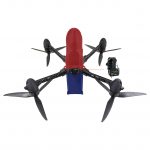
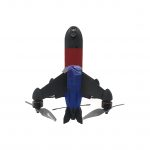

The proliferation of small commercial drones has created a dual-edged reality. While drones bring efficiency to countless industries, they also pose severe security risks—from unauthorized surveillance over critical infrastructure to weaponized drone attacks observed in modern conflicts. Addressing this threat requires a defensive capability that is equally agile and intelligent. Enter the high-speed AI drone, which has emerged as a cornerstone of modern counter-drone (C-UAS) operations and autonomous perimeter patrol.
AI-Powered Drone Detection & Identification
Traditional radar struggles to differentiate a small drone from a bird. High-speed AI drones overcome this with onboard AI and computer vision. For instance, researchers at Julius Maximilian University of Würzburg have developed an autonomous interceptor drone that uses LiDAR sensors to detect intruders, then employs AI-based recognition to confirm the target is a drone—not a bird or harmless object—before launching a capture net. This ability to rapidly classify threats is essential for reducing false alarms and ensuring reliable airspace security.
Similarly, the NATO‑developed c‑UAS prototype, successfully tested at the Bold Machina exercise in 2025, demonstrated how AI can fuse data from multiple sensor platforms to detect and identify Class 1 drones. Powered by an Nvidia Jetson developer kit, the system refines real‑time detection models and updates threat libraries on the fly. This edge‑AI approach allows AI drones to make millisecond‑level decisions without cloud dependency.
Multi-Layered Counter-Drone Systems
Modern high-speed AI drone defenses are not monolithic—they operate as layered systems. D‑Fend Solutions‘ EnforceAir PLUS, for example, is a cyber-driven, multilayer C‑UAS that combines RF‑cyber detection and takeover technology with auto‑calibrated radar and optional jamming. Its AI‑enhanced SmartAir fusion engine synthesizes sensor inputs and automatically suggests response actions, reducing operator workload while enabling real‑time decision‑making. This approach allows defenders to escalate from soft‑kill (cyber takeover) to hard‑kill (kinetic interception) as threats evolve.
In the hard‑kill category, Germany‘s net‑firing interceptor drone represents a breakthrough in “non‑collateral” interception. The high‑speed AI drone closes in on its target, deploys an extendable net mid‑flight, and captures the intruding drone safely, allowing security agencies to retrieve forensic data about its origin and operator. Such designs are particularly suited for protecting airports, stadiums, prisons, and other sensitive sites where explosive downing is unacceptable.
AI Drone Patrol for Border & Perimeter Security
Beyond active interception, high‑speed AI drones excel at preventative patrolling. The “Eagle Patrol” drone system deployed along China‘s border in Inner Mongolia operates across 1,103 kilometers of borderlines. Its drones perform autonomous takeoff, cruising, charging, and networking. Through an intelligent dispatch platform, operators can simultaneously control multiple drones to perform diverse tasks—long‑endurance fixed‑wing drones for broad aerial surveillance and multi‑rotor drones for low‑altitude refined inspection. All units are equipped with domestic BeiDou navigation modules, ensuring key technologies remain sovereign.
Similarly, the EU’s Frontex and Bulgarian Border Police concluded a pilot project in 2025 that covered 8,100 square kilometers, testing long‑ and short‑endurance drones equipped with high‑tech surveillance systems. The mobile surveillance system integrated multiple data sources—drone footage, infrared cameras, and tactical drone feeds—into a single operational picture using GIS tools, enabling real‑time situational awareness to be shared securely with teams on the ground.
AI-Enhanced Threat Identification
The next frontier is AI that not only spots drones but also recognizes what they carry. ZeroEyes Aerial Detection Kit, launched for public safety agencies, deploys a drone‑based solution that can detect firearms, people, vehicles, drones, and maritime vessels in real time through a live camera feed. Detections are instantly viewed by law enforcement and dispatched to on‑site staff, supporting scenarios ranging from event security to armed assailant tracking. When this capability is integrated with high‑speed interceptors, it creates an end‑to‑end kill chain: detect, classify, track, neutralize.
Swarm Intelligence & Future Outlook
The convergence of AI and drone swarms is reshaping the battlefield. Auterion’s Nemyx, a swarm strike engine, enables drones from multiple manufacturers to act as one coordinated force, executing AI‑guided missions at speed and scale. For perimeter defense, such swarms can blanket a large area, share threat data instantly, and coordinate interception with minimal human oversight.
As AI models grow more efficient and edge chips become cheaper, the high‑speed AI drone will transition from a specialized counter‑UAS tool into a ubiquitous element of smart airspace governance. The same drone that patrols a border today may autonomously intercept a hostile drone tomorrow. From net‑firing interceptors to AI‑driven patrol networks, the era of intelligent aerial security has arrived—and it is flying at high speed.
