
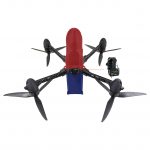
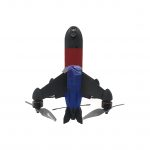

The term rocket FPV drone is not just marketing hype. It describes a class of first‑person view quadcopters engineered for extreme speeds—often exceeding 150 mph (240 km/h). Achieving such performance requires a deep integration of propulsion, electrical, thermal, and aerodynamic technologies. This article breaks down the core technical systems that turn a standard racing drone into a true rocket FPV drone.
1. Propulsion System: High‑KV Motors & Propeller Matching
At the heart of any rocket FPV drone is its motor‑propeller combination. Unlike cinematic drones that prioritise efficiency, rocket builds use brushless motors with high KV ratings (e.g., 2700–3500 KV for 4S, or 1700–2000 KV for 6S). KV indicates RPM per volt. A 2000 KV motor on 6S (25.2 V) spins at over 50,000 RPM unloaded.
However, high RPM alone is insufficient. The propeller must be carefully selected. Low‑pitch props (2.5–3 inches) accelerate faster but cap top speed; high‑pitch props (4–5 inches) deliver higher terminal velocity but require more torque. Engineers often use thrust stands to measure static thrust and then simulate dynamic thrust loss due to pitch speed. A well‑tuned rocket FPV drone achieves a thrust‑to‑weight ratio above 8:1, enabling vertical acceleration comparable to a drag racing car.
2. Battery Chemistry & Discharge Limits
Speed demands instantaneous power. Standard Li‑Po batteries cannot sustain the current draw of a rocket FPV drone. Pilots use high‑C rated packs (120C continuous or higher). For extreme builds, 8S (33.6 V) systems push motor RPM beyond 70,000, but they require ESCs rated for 80A continuous.
Internal resistance becomes critical. At 150+ mph, a battery with high internal resistance will experience voltage sag, reducing thrust and potentially causing a desync. Serious builders measure cell resistance with a milliohmmeter and only match cells below 2 mΩ per cell. Graphene‑enhanced Li‑Pos or Li‑HV (high voltage) chemistries are preferred for their lower voltage drop under load.
3. Electronic Speed Controllers & Firmware Tuning
The ESC on a rocket FPV drone must handle brutal current spikes. Many use 32‑bit ARM processors running BLHeli_32 or AM32 firmware. Key settings include:
-
Motor timing – Medium‑high to high (22°–25°) for extra RPM at the cost of heat.
-
Demag compensation – Disabled or low to avoid false over‑current shutdowns.
-
PWM frequency – 48 kHz to reduce motor noise and slightly improve efficiency.
Active braking (damped light) is mandatory; it allows the propeller to slow down instantly when throttle is cut, improving control response during high‑speed turns.
4. Aerodynamics & Drag Reduction
At 150 mph, aerodynamic drag is the single largest force opposing thrust. A rocket FPV drone uses a streamlined frame with as few protrusions as possible. Builders sand sharp edges, recess antennas into the frame, and use 3D‑printed air scoops that double as structural elements. The cross‑sectional area is minimised by stacking components vertically.
Even propeller design affects drag. Some racers use ducted fan style frames or bi‑blade props instead of tri‑blade to reduce blade area. The trade‑off is lower static thrust for higher top speed.
5. Thermal Management
Heat is the silent killer. Motors, ESCs, and batteries generate enormous thermal loads during a 2‑minute full‑throttle run. Rocket FPV drone engineers implement active cooling: airflow channels guide incoming air over ESC heatsinks and through motor stator windings. Some custom builds incorporate tiny 5 V blower fans that activate above 80°C.
Telemetry logs often show ESC temperatures exceeding 110°C and motor windings reaching 140°C. Using high‑temperature magnets (rated for 150°C+ and neodymium with H‑ or SH‑grade) prevents demagnetisation. Thermal paste between the ESC and frame helps conduct heat away.
6. Flight Controller & Gyro Filtering
Standard PID controllers oscillate at extreme speeds due to airframe resonance. A rocket FPV drone relies on high‑rate gyro sampling (8 kHz or 32 kHz) and advanced filtering. Betaflight’s RPM filter uses motor telemetry to cancel noise at specific harmonics. Dynamic idle and thrust linearisation prevent propwash oscillations during hard deceleration.
Many competitive rocket builds use a dedicated F7 or H7 flight controller with a BMI270 or ICM‑42688‑P gyro for lower noise floor. The PID loop frequency is set to 8 kHz (or 4 kHz for 8S builds), with D‑term damping increased to prevent thermal runaway on the motors.
Future Developments
Silicon carbide MOSFETs, active rotor cooling, and AI‑based predictive motor timing are on the horizon. For now, building a rocket FPV drone remains a blend of mechanical engineering, electrical tuning, and risk management. Each component is pushed to its limit – and sometimes beyond. That is the essence of rocket FPV technology.
